
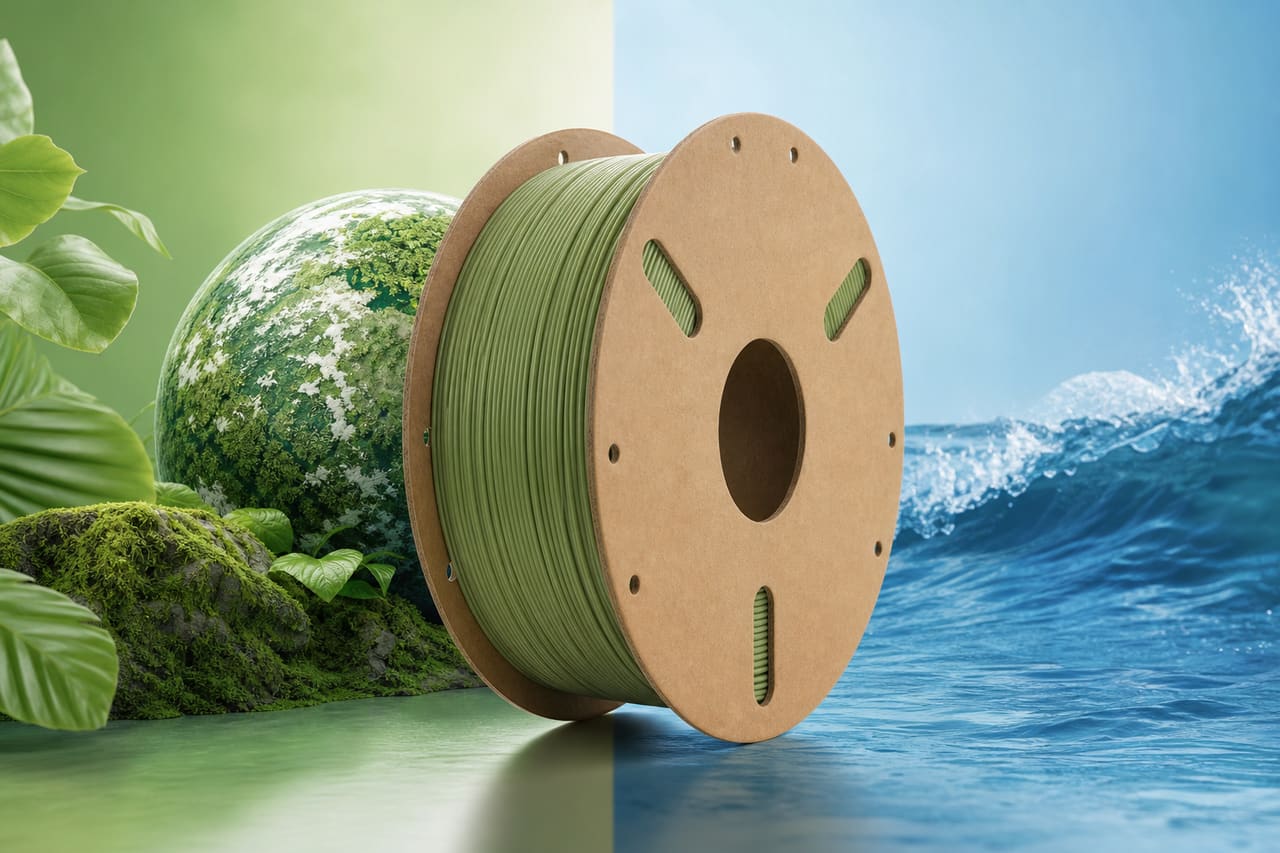
EU PPWR (Packaging and Packaging Waste Regulation), Germany's VerpackG, Nordic plastic taxes, Japan's Plastic Resource Circulation Act, and Korea's resource circulation rules are reshaping global B2B filament procurement. Distributors, sustainable brands, and OEM buyers no longer ask only "does it print well?" — they ask: Is it bio-based? Does it break down in soil, freshwater, or marine environments? Does it create microplastics? Can it pass EPR and green procurement audits? On those questions, the gap between PHA (polyhydroxyalkanoate) and PLA or PETG determines whether your SKU can enter high-regulation markets such as Germany, the Netherlands, Sweden, Japan, and Korea.
PLA (polylactic acid) is often marketed as "biodegradable," but in practice PLA mainly breaks down in industrial composting facilities (~58°C+, controlled humidity). In ambient soil, freshwater, or marine conditions it degrades very slowly, and fragmented particles can persist as microplastics. PETG is a petroleum-based glycol-modified polyester — excellent toughness and moisture tolerance, but not biodegradable and typically classified as conventional plastic in ESG and carbon reporting. By contrast, bio-based PHA filament is 100% bio-based, synthesized via microbial fermentation from renewable carbon, and designed to biodegrade in soil, freshwater, marine, industrial, and home compost environments with zero microplastic residue — the core material difference for eco-conscious channels.
Polyhydroxyalkanoate (PHA) is a natural polyester bacteria store as energy when nutrients exceed growth needs. Commercial PHA filament is optimized for FDM/FFF: print temperature 200–210°C, up to 200–300 mm/s throughput (50–100 mm/s recommended for best surface quality), fast crystallization, minimal stringing. Mechanically: HDT >85°C, tensile strength 16–19 MPa, impact 5–15 kJ/m², elongation at break >50% — balancing sustainability storytelling with manufacturability. Diameter 1.75 mm ±0.05 mm; dry at 65°C for 4–8 h before printing — moisture sensitivity similar to PETG, so factory moisture control is critical for stable B2B supply.
Environmental advantages versus PLA and PETG cluster in four areas: (1) End-of-life pathways — including marine degradability for items that may reach waterways: promotional goods, education models, packaging concepts. (2) Barrier performance — WVTR ~4 g/m²·24h and OTR ~6 ml/m²·24h, roughly 10× better than PLA, suited to food-contact concept parts and fresh-packaging mockups. (3) Production emissions — bio-fermentation routes can cut emissions up to ~90% versus traditional plastics. (4) Certification stack — TÜV OK biodegradable SOIL / WATER / MARINE, DIN compost, BPI, USDA Biobased — helping importers satisfy EU, North American, and East Asian documentation requests.
German and broader EU buyers focus on verifiable claims, not slogans. VerpackG and LUCID registration demand packaging responsibility transparency; PPWR pushes recyclability and recycled content targets. For 3D printing channels, PHA works as a sustainability flagship SKU: eco-brand OEM, museum gifts, corporate ESG merchandise, education kits, compostable packaging concepts — scenarios where PLA's "industrial compost only" narrative often fails corporate procurement review, and PETG cannot support biodegradability claims at all. Quote PHA alongside PLA Basic and PETG as a "volume + functional + sustainable" trio.
Nordic markets (Sweden, Norway, Denmark, Finland) are highly sensitive to plastic pollution and carbon impact; retail and public procurement increasingly require bio-based content and end-of-life pathway documentation. PHA's combination of marine degradability and home/industrial compost certifications helps distributors prove material choice to municipal, design, and education clients. Japan's Plastic Resource Circulation Promotion Act strengthens mono-material and recycling requirements; Korea is tightening single-use plastic rules — B2B buyers in both countries increasingly filter on petroleum-based vs bio-based first. Most OEM suppliers provide full TDS / COA / MSDS export documentation, FOB from ~50 kg MOQ, supporting direct supply from Asia source factories into Europe and East Asia.
Print performance: PHA is not a fragile lab-only material. Recommended settings: nozzle 200–210°C; Cool Plate / SuperTack bed 20–45°C, or Textured PEI 50–70°C (avoid Textured PEI in fully enclosed chambers); brim 5–10 mm; retraction 0.8–1.0 mm; part cooling fan 100%. Compatible with Bambu Lab, Creality, and common FDM hardware; 0.4 mm or larger nozzle. Batch variance is normal for bio-fermented materials — tune flow ratio 1.016–1.026 and K factor 0.015–0.035 per roll. Use 200–300 mm/s for production throughput; 50–100 mm/s for display-grade surface quality.
Versus PLA: PLA offers the widest print window (190–220°C), low odor, and ±0.03 mm diameter tolerance — the world's highest-volume desktop material for education, figurines, and display. But PLA HDT is ~57°C with weak heat and moisture resistance; "biodegradable" depends on industrial compost infrastructure and is a poor basis for marine-friendly or home-compost marketing. PHA HDT >85°C fits more functional use cases and supports marine / soil / compost degradation claims. If your buyers are EU eco-brands or Japan/Korea sustainable design studios, PHA is an upgrade SKU PLA cannot replace; if buyers need lowest-cost entry filament, PLA remains the volume line — stock both.
Versus PETG: PETG is the functional workhorse — HDT ~70°C, impact ~32 kJ/m², better moisture tolerance than PLA; Matte and transparent grades cover containers, fixtures, and cosmetic parts. PETG's weakness is ESG: petroleum-based, not biodegradable, not compostable. PHA impact is lower (5–15 vs ~32 kJ/m²) and not a drop-in for heavy structural or long outdoor UV duty (ASA remains the outdoor choice). Where buyers need degradability + food-contact concept potential + green brand story — sustainable packaging mockups, hospitality concept models, medical implant prototypes — PHA delivers what PETG cannot. B2B strategy: PETG for functional margin, PHA for sustainability premium.
Applications: (1) Sustainable prototypes and eco-brand OEM private-label lines; (2) Eco décor, art installations, and education models for schools and museums; (3) Packaging mockups and food-contact concepts (buyers must validate end-use regulations); (4) Fashion pieces and home artwork — Silk metallic and Candy/Jade translucent series; (5) Medical implant prototypes and biocompatibility research (laboratory use, not finished medical devices). Quality PHA filament is typically engineered toward FDA, EFSA, and CFSA compliance pathways; importers should still perform legal review for target markets.
Color system: four series, 18 colors — Natural (natural / white / black) for minimal eco-brand aesthetics; Silk (yellow / white / silver / red) for metallic display parts; Candy / Jade (blue / green / yellow / white / black / jade / red / pink) translucent tones for design-led SKUs; Biomass (coffee grounds / tea residue / orange peel) with visible bio-speckle for dual visual and narrative differentiation — ideal for Germany- and Nordics-oriented design buyers. OEM spooled, spool-less, Refill, and private-label boxes share the same factory QC system as PLA and PETG.
Sourcing checklist: (1) Request TDS plus biodegradability / biobased certification copies; (2) Confirm diameter reporting (PHA ±0.05 mm) and drying instructions on packaging; (3) Sample print for stringing, interlayer strength, surface finish; (4) Verify MSDS and REACH / RoHS statements; (5) Review MOQ and lead time — typical FOB MOQ from ~50 kg, 1–2 sample spools per color. Share this guide with PHA product spec pages to reduce distributor support load.
If you are building a sustainable 3D printing catalog for EU, German, Nordic, Japanese, or Korean channels, consider Qianshuo PHA as your biomaterial flagship alongside PLA volume lines and PETG functional grades. Visit <a href="/products/biomaterial/pha">/products/biomaterial/pha</a> for full specs, color series, and certification notes; email evans@qs3dprinterfilament.com or WhatsApp +852 5307 0568 for samples and wholesale quotes.
PHA vs PLA comparison
| Property | PHA | PLA |
|---|---|---|
| Feedstock | 100% bio-based (microbial fermentation) | Plant-based (corn, etc.) — not marine-degradable |
| Soil / freshwater / marine breakdown | Certified degradable; zero microplastic design goal | Mainly industrial compost; very slow in marine/soil |
| Heat deflection (HDT) | >85°C | ~57°C |
| Impact strength | 5–15 kJ/m² | ~26 kJ/m² |
| Tensile / flexural strength | 16–19 / 18–23 MPa | ~50–75 MPa (grade-dependent) |
| Moisture / oxygen barrier | ~10× better than PLA | Baseline |
| Print temperature | 200–210°C | 190–220°C |
| High-speed print | 200–300 mm/s | Typically 60–150 mm/s |
| Diameter tolerance | ±0.05 mm | ±0.03 mm (premium lines) |
| Typical B2B role | Sustainability flagship / eco OEM | Volume / education / display |
PHA vs PETG comparison
| Property | PHA | PETG |
|---|---|---|
| Feedstock | 100% bio-based | Petroleum-based polyester |
| Biodegradable / compostable | Soil / freshwater / marine / compost | Not biodegradable |
| Heat deflection (HDT) | >85°C | ~70°C |
| Impact strength | 5–15 kJ/m² | ~32 kJ/m² |
| Moisture tolerance | Moderate (dry before print) | Better |
| Print temperature | 200–210°C | 220–250°C |
| ESG / carbon narrative | Strong (bio-based + degradation certs) | Weak (conventional plastic) |
| Typical B2B role | Sustainable concepts / packaging / medical proto | Functional parts / containers / fixtures |
Frequently asked questions
Both PHA and PLA are called "biodegradable" — what is the real difference?
PLA mainly breaks down in industrial composting; it degrades very slowly in marine and ambient soil conditions and can persist as microplastics. PHA is designed to biodegrade in soil, freshwater, marine, and compost environments, backed by TÜV OK SOIL / WATER / MARINE certifications — better suited to EU and East Asian buyers auditing end-of-life pathways.
Can PHA replace PETG for structural parts?
Not recommended. PETG offers higher impact toughness (~32 kJ/m²) for load-bearing functional parts. PHA fits sustainable concept parts, packaging mockups, and display/education models where degradability matters more than peak mechanical strength.
Which markets should prioritize PHA SKUs?
Germany, the EU (PPWR / VerpackG), Nordics, Japan, and Korea — plus eco-brand OEM, museums, corporate ESG merchandise, and education kit channels.
Does PHA require drying before print?
Yes — 65°C for 4–8 hours. Moisture causes popping and weak layers, similar to PETG. Include drying guidance on OEM packaging and TDS.
Is PHA food-contact safe?
Quality PHA filament is typically engineered toward FDA, EFSA, and CFSA compliance pathways for food-contact concepts. Final food-contact use must be validated by the buyer in the target jurisdiction.
Wholesale MOQ and samples?
Typical FOB MOQ from ~50 kg; request 1–2 sample spools per color for comparison prints. Contact evans@qs3dprinterfilament.com or WhatsApp +852 5307 0568.
What color series are available?
Four series, 18 colors: Natural, Silk metallic, Candy/Jade translucent, and Biomass coffee/tea/orange-peel speckle. See /products/biomaterial/pha.
Which import documents are needed?
Commercial invoice, packing list, and MSDS are standard; add biodegradability and biobased certification copies, COA, and REACH statements for EU and East Asian customs and ESG audits.