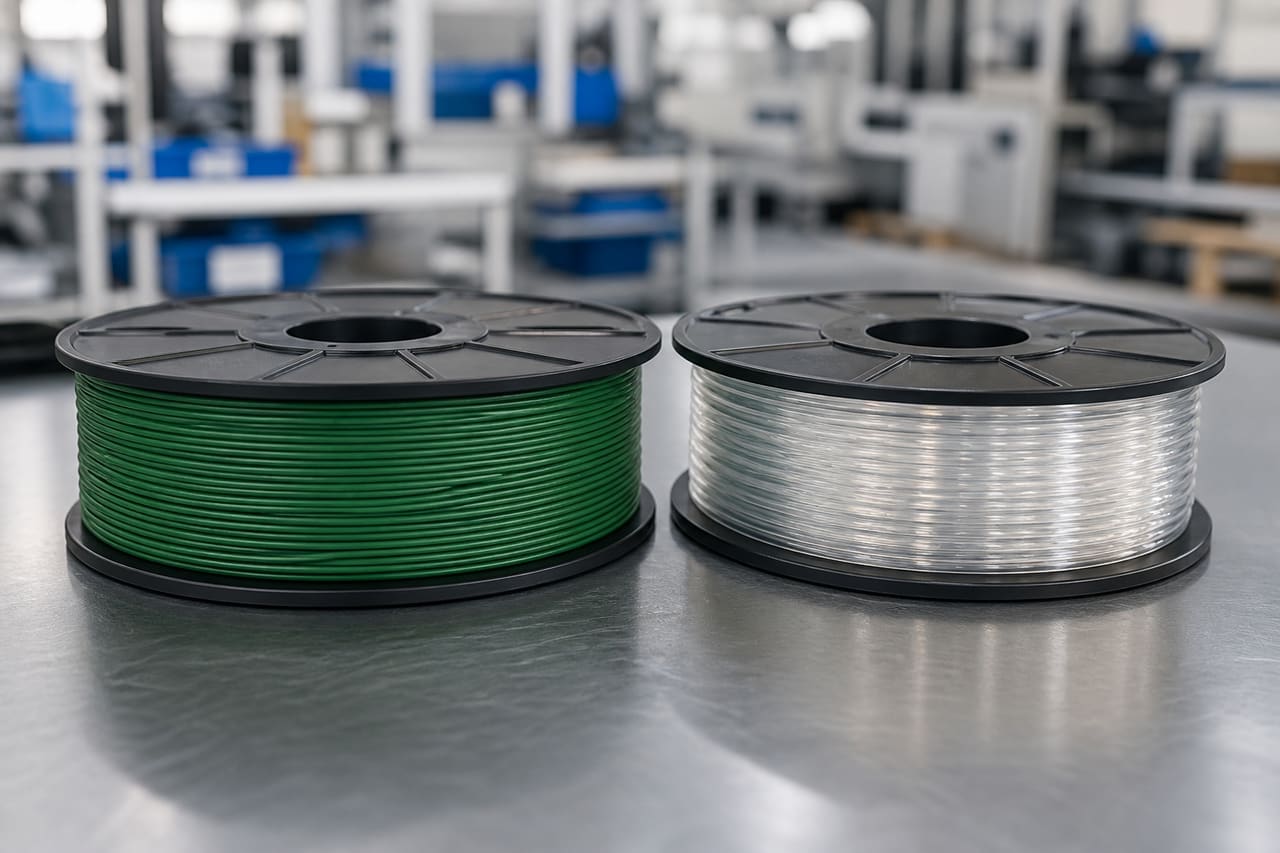
Distributors, e-commerce sellers, and OEM brands building a 3D printer filament line almost always ask the same question first: should we lead with PLA or PETG? PLA moves volume, prints easily, and supports broad color catalogs. PETG offers stronger layers, better moisture tolerance, and fits functional plus semi-transparent parts. Picking the wrong default material drives returns, bad reviews, and expensive re-sampling. This guide gives a factory-backed framework for wholesale selection.
PLA (polylactic acid) remains the most common desktop FDM material worldwide. It has a wide print window, low odor, and fits education, prototyping, and display models. For high-volume base colors, buyers care about color consistency, diameter stability, and reliable spooling. Qianshuo PLA uses inline laser diameter control at ±0.03 mm, available in 1.75 mm and 2.85 mm, and works well as an OEM entry SKU or e-commerce “default filament.”
PETG ( glycol-modified PET) balances between PLA and ABS: tougher and more moisture-resistant than PLA, yet generally easier to print than ABS. Matte PETG reduces glare for product photography. Clear and translucent PETG suits lampshades, containers, and display parts. PETG requires tighter moisture and stringing control at the factory — stable B2B supply depends on drying discipline and extrusion QA, not just low unit price.
Most B2B programs follow a “PLA for volume + PETG for margin + engineering for differentiation” mix. PLA Basic / PLA+ / Silk / Matte cover retail mainstream. PETG and Matte PETG cover functional and cosmetic SKUs. When customers need higher stiffness, CF-PLA or CF-PETG completes the ladder. One coherent catalog can cover roughly 80% of channel demand while leaving room to upsell.
When evaluating a supplier, unit price is only the starting point. Check: (1) diameter tolerance and ovality reports; (2) batch COA / TDS; (3) color ΔE control; (4) whether spooled, spool-less, and refill formats share the same QC standard; (5) OEM private-label MOQ and lead time. Qianshuo is a Foshan source factory with 50 kg MOQ, OEM packaging, and full TDS / COA / MSDS export documentation.
Print parameters directly affect end-user experience and your support burden. Typical ranges: PLA nozzle 190–220°C, bed 50–60°C; PETG nozzle 220–250°C, bed 70–85°C. PETG should not be over-cooled or layer adhesion suffers. PLA relies on adequate part cooling for detail. Printing recommended settings on the box or via QR link reduces distributor support tickets measurably.
Packaging and logistics increasingly influence repeat orders. EU and North American channels ask for cardboard spools, spool-less rolls, and refill systems compatible with Bambu Lab, Prusa, and other ecosystems. Quote spooled and refill options on the same price sheet so buyers can map SKUs to their hardware base. Qianshuo supports spooled, spool-less, and refill formats from one factory QC system.
Compliance matters for customs and corporate buyers. Keep MSDS and relevant REACH / RoHS statements available with shipment or on your official site. Some import checks ask for material safety data at border. Using qs3dprinterfilament.com product pages and technical blog posts as a self-service knowledge base also strengthens how Google and AI answer engines perceive your factory expertise.
If you are re-qualifying an Asia filament source, start with side-by-side samples: one to two spools of PLA and PETG. Test stringing, bridging, diameter feel, and pack moisture protection before committing to a 50 kg MOQ or OEM color program. Contact evans@qs3dprinterfilament.com or WhatsApp +852 5307 0568 for pricing and sample options.
PLA / PETG / ABS specification comparison
| Property | PLA | PETG | ABS |
|---|---|---|---|
| Nozzle temp | 190–220°C | 220–250°C | 230–260°C |
| Bed temp | 50–60°C | 70–85°C | 90–110°C |
| Heat deflection (HDT) | ~55–60°C | ~70–80°C | ~85–100°C |
| Impact toughness | Low–medium | Medium–high | Medium–high |
| Moisture sensitivity | High (dry storage) | Moderate | Moderate |
| Print difficulty | Easy | Moderate | Harder (enclosure helps) |
| Typical B2B use | Models, education, display | Functional parts, containers | Housings, heat-facing parts |
| Recommended tolerance | ±0.03 mm (laser inline control) | ||
Frequently asked questions
Should we stock 1.75 mm or 2.85 mm for wholesale?
Global desktop share is overwhelmingly 1.75 mm (often 90%+). 2.85 mm serves Ultimaker-class machines and some NA education fleets. Lead with 1.75 mm SKUs; offer 2.85 mm as a secondary line.
How important is ±0.03 mm tolerance for B2B?
Tolerance drives flow stability, surface quality, and jam rate. ±0.03 mm is a common requirement for serious wholesale and OEM programs and reduces end-user support cost.
PLA or PETG for outdoor parts?
Do not use PLA for long outdoor heat and UV exposure. PETG works for shorter outdoor cycles; ASA is better for long-term UV and heat.
What MOQ applies to OEM private label?
Qianshuo FOB Foshan typically starts at 50 kg for material. OEM boxes and labels depend on color count and packaging — often combined with the first production batch.
How do we qualify a new filament factory quickly?
Request TDS, diameter reports, and sample spools; compare stringing and layer strength; verify export docs and batch traceability before scaling PO size.
Can PLA and PETG ship in one container?
Yes, with separate moisture-safe packaging and clear SKU labeling. Note dry-storage instructions on packing lists — PETG is more humidity-sensitive in transit.
Which documents do importers need?
Commercial invoice, packing list, and MSDS are standard; some markets request COA or REACH statements. Qianshuo supplies TDS / COA / MSDS.
Matte PETG vs standard PETG positioning?
Matte PETG is low-glare and photo-friendly for retail channels. Standard PETG balances clarity and layer performance for functional parts. Stock both when possible.